Trauma Healing | Developmental and Relational Trauma | Somatic Therapy

Consultant psychologically informed Chartered Physiotherapist | Somatic trauma therapist | Clinical specialist in integrated medicine.
BSc(Physio) MCSP MHCPC MAACP SEP EMDR CST NATP | HCPC PH46080 | CSP 52922 | Over 36 years in practice | Wokingham, Berkshire
How I work
The work begins from the moment you reach out to enquire. Even here. I have spent decades building a physical bricks and mortar Practice in the heart of Wokingham. Building a team around me with a front out house team trained and skilled to be able to support you and make the whole patient experience feel as smooth and supportive as possible.
When we meet, the awareness and slow tracking forms part of the work and are often more important than the verbal story you might need to bring. I want to hear you, but I am here to help you understand and repair patterns in your nervous system and body which might go unnoticed.
I blend together many approaches in a way that hopefully you may not even be aware of. The relational safety building comes first.
Slowness and awareness are always key elements – we go at a pace which your mind and body can handle. That might mean in interrupt and slow you down – I am not being rude – I am taking care of you and helping us become aware of patterns and learning to find ways to change them to afford better health in mind body and spirit.
One journey, many threads
People sometimes ask which technique they should book. The honest answer is none. I rarely use one on its own.
Somatic Experiencing®, NeuroAffective Touch®, manual therapy, perhaps, talk therapy / conversation, developmental and attachment trauma therapy, Maybe EMDR blend through the sessions as we go, and the mix can change as you change.
Come as you are, and we travel the journey together.
Safety first - Slow and steady
Before anything else we build enough steadiness to look at difficult things without being swamped. This is not a delay. It is the work.
We set the pace and the path together
You can say no, pause, change direction or stop at any point. There is space for lots of education and sharing about what is going on if needed. It is my job to ensure you are safe and your body as well as mind are not re-traumatised. If it feels too much for you, you can say and I will adjust.
Body and story together
We follow what your body does as you talk, and what your story does as you notice your body.
Think about this for a moment – where do you feel anything? Your body.What happens in your body when you think about something difficult. Perhaps it tenses, maybe a small breath change, perhaps the eyes look away, perhaps subtle or great things happen in our awareness. This is the somatic element that runs along with the thought.
People often wonder is somatic therapy involves and supports the thought and whether they need talk therapy and counselling as well. You are welcome to combine both but most of my patients find it is not necessary. Meaning and cognitive processes are part of this work.
The length of the work
How long our healing journey lasts will vary a great deal.
Some people come for a few sessions to tackle a single event trauma or help with a specific difficulty.
Others work with me over many months and even years. Dealing with chronic patterns in the nervous system which likely developed many years ago and have been our internal “operating system” requires correction, repetition and careful slow work to remedy.
It really depends on what you need help with. There is no tie-in.
It is common for people to come thinking they need help with a physical symptom like chronic migraines or fibromyalgia and end up really enjoying the opportunity to address things which they didn’t realise I could help with -like life long issues with shame or relationships or anxiety.
It is important in some cases that we manage ending a journey together carefully. If the work involves, in part, repairing and working with attachment trauma, sudden stops can re-traumatise so we speak about this and negotiate this carefully together.
What a typical session looks like
- Introductory conversation to see if we are a good fit
- A few sessions to build steadiness and understand your patterns
- Deeper work at a pace you can manage
- Regular reviews, and a planned ending
The principles I work by
- Safety before depth: we build steadiness first
- Consent as a continuing conversation
- Following your body’s pace, not a protocol
- Honesty about what I can and cannot help with
- Looking at the whole picture: physical, neurological psychological, emotional and even spiritual
Working with other professionals
I am glad to coordinate with your GP, psychiatrist or other therapist, with your consent.
When I might refer you on
If something is outside my scope, I will say so and work with your GP or consultant so you can receive the best, most appropriate treatment for you.
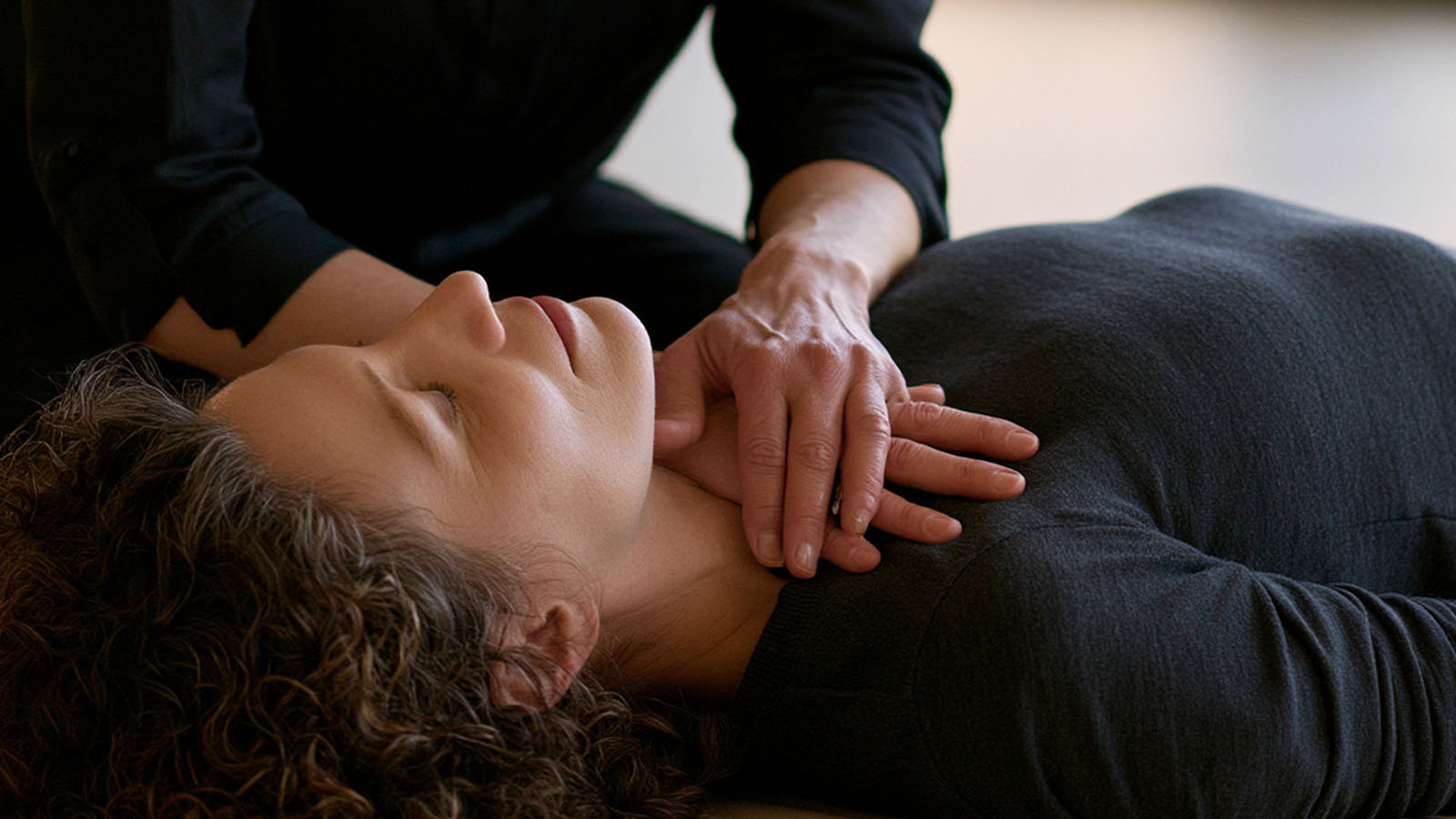
Skilled touch, only if you consent
I explain what I would do and why, and I check with you again as we go. Many people never use touch, and that is a perfectly good way to work.
Why touch at all?
Many trauma practitioners no longer use touch. That caution is understandable. Used with care and with your agreement at every step, it can help a nervous system that has not felt safe to settle, and it can reach what words do not.
As babies, before we could speak, we were settled by touch, by presence, by sound. As adults – we still have that available to us.
In NeuroAffective Touch – specially designed and shaped warm pillows are used beautifully to add sensory signals to the body which can have powerful impacts in helping a person feel shifts in their system.
Is this therapy / work mainly touch therapy?
My touch skills come from decades of hands-on physiotherapy, combined with training in trauma-informed body approaches.
However – most of my day is spent with people not on the therapy couch. It might resemble a more traditional therapy session but with key differences.
We will be slowing things down beyond the narrative and checking in with the other parts of our human experience, like body awareness (if accessible in even a small way).
If the body feels offline, touch might be a great way to regain this. Perhaps you find you are too aware of sensations in your body and worry about them. It may be that we need to stay well away from touch and work in other areas besides sensation to reduce a hyper vigilance if you have experienced abuse and your system is on red alert.
The work if so varied and its scope is vast – more than we can ever do justice on this page.
Is touch safe in trauma therapy?
It can be, when it is consented, explained, paced and optional. In most cases it can be incredibly healing when joined up with mind and body somatic therapy skills.
It can also do harm when it is not done well and not attuned and well consented. That is why the conditions matter more than the technique. For people who have experienced sexual harm, see touch and repair after sexual harm.
How consent works
- Consent is a moment-to-moment process in this work not a one-off question
- Many people have never had boundaries respected, or need them too tightly held
- Invitational language – you will find I always say things like.. “how would it be if…. or I wonder, would it be ok if we … or Would it be ok if I put my hand on your back… ” and so on
- You can say no, change your mind or stop at any moment
- We agree where touch is welcome and where it is not
- Although I am skilled in bodywork and touch – it is never required to work with me
How is it different to normal therapy?
- Think of it like talk therapy and psychotherapy with body elements added
- Trauma is in the body as well as the mind and so we need to work with not only mind
- It is not just you talking and me listening
- There is space for you to be whatever you need – to talk yes, to be still, to move, to be angry, to learn about not only thoughts, but unconscious body responses
- It may or may not involve touch
- You cannot talk your way out of trauma – many people have spent years in traditional there – I did – and still not resolved responses in the body. This work joins mind and body and her deeply.
Where my touch skills have come from
Over 36 years of hands-on physiotherapy have taught me how to read tissue and tension, and how to be precise and unhurried. I combine that with training in trauma-informed body approaches.
In Safe hands
I have worked as a physiotherapist for over 36 years, with touch, movement and manual therapy at the centre of my practice.
I am trained to assess and diagnose, and to spot anything that needs onward medical referral, which I arrange. I have strong working relationships with consultants and the wider medical community, so your care is joined up and nothing is missed.
Frequently asked Questions
Aren't you a just a Physiotherapist though?
No. This is why I have built this new website – to create clarity for people. I still run and own the Physiotherapy Practice which has been around for over 30 years now.
However; I have many other qualifications and trainings and now I am best identified as a Somatic Trauma Therapist or Somatic Psychotherapist
Which technique will you use?
Usually several, blended as we go. I rarely use one on its own, and you do not need to choose.
What happens in the first session?
A conversation about what brings you and what you want, and a discussion of how we might work. There is no pressure to go into detail.
Can I bring someone with me?
Yes of course although I find most people prefer not to or find they ask the person to leave part way through the first session but yes – they are welcome. Especially if you struggle meeting new people or have memory problems.
Before you do so, please do get in touch and speak to either myself or a member of my team.
Do I have to be touched?
No. Many clients never use touch.
Through decades of experience and training, I have developed a suite of therapeutic techniques to meet you where you are and provide the best therapy for your needs.
What does consent look like?
It is explained first, agreed, and rechecked as we go. You can say no or stop at any time.
Do I stay clothed?
Yes you do. You will always feel absolutely feel safe during your sessions and it is my role to earn your trust so we can travel your healing journey together.
A space for your healing journey
Whilst I recognise that your system may not “feel” safe – I recognise that and work with it in the session and, over time, create a space in which you can feel an ever increasing sense of internalised safety.
Rodger Duckworth sees clients at The Grange Health in Wokingham, Berkshire, and works with people from Wokingham, Reading, Bracknell, Crowthorne, Finchampstead, Winnersh, Binfield, Swallowfield, Hurst, Twyford, Henley-on-Thames, Sonning and the surrounding area.
Sessions are available in person or online.
The Grange | 15 Rectory Road | Wokingham | RG40 1DJ | 0118 978 6149
Whenever you are ready
A first message does not commit you to anything. Reception will help you find the right time.